
Sarah Peebles: Composer/Performer

Resonating Bodies

Information, images and updates at
http://resonatingbodies.wordpress.com and interacces.org
Gallery notes here: pdf


Description  |  Pink Bee-Wasp Condo  |  Notes on Bees  |  Speakers Series  | Credits/Biographies

July 4-27, 2008
Resonating Bodies - Bumble Domicile
Sarah Peebles, Rob King, Anne Barros and Robert Cruickshank
*new* gallery, 906 Queen W., Toronto (corner of Crawford and Queen W.)
Co-presented by InterAccess (interaccess.org) and New Adventures in Sound Art (NAISA.ca)

July
Speakers Series: Indigenous Pollinators, Habitat and Co-evolution
Collaborating researchers speak about pollinator biodiversity, habitat and related topics throughout the month of July at InterAccess Studio, the Franklin Children’s Garden and various venues.
Co-presented by Seeds of Diversity, InterAccess, Dorkbot and Franklin Children’s Garden. See details, below.

Sarah Peebles - audio installation; project lead
Rob King - data visualization
Anne Barros - copper offering plate, silver bowl
Rob Cruickshank - ultraviolet video; technical assistance and consultation
Collaborating researchers: Laurence Packer (York University), Jessamyn Manson (University of Toronto), Peter Hallett (University of Toronto), and Stephen Buchman (University of Arizona, Tucson).

DETAILS

Resonating Bodies is a series of mixed media installations and community outreach projects which focuses on biodiversity of pollinators indigenous to the natural and urban ecosystems of the Greater Toronto Area. Conceived by Sarah Peebles with Rob King, Rob Cruickshank and Anne Barros, the installations illuminate aspects of local biodiversity such as bumblebee colonies and their foraging activities, ultraviolet bee vision, pollinator/plant co-evolution, solitary bee and wasp nesting life/life cycles, and colour-coded DNA barcodes (a novel new technique for species identification pioneered by Canadian researchers). Resonating Bodies coincides with the release of Toronto’s first guide to native bees, “A Guide to Toronto's Pollinators”, by Laurence Packer, Professor of Biology at York University (published by the David Suzuki Foundation). The theme of the booklet — some 23 genera of bees found in Toronto — is woven into the fabric of the project on several levels, with talks on related topics by collaborating researchers Laurence Packer, Jessamyn Manson, Peter Hallett and Stephen Buchman (see details).

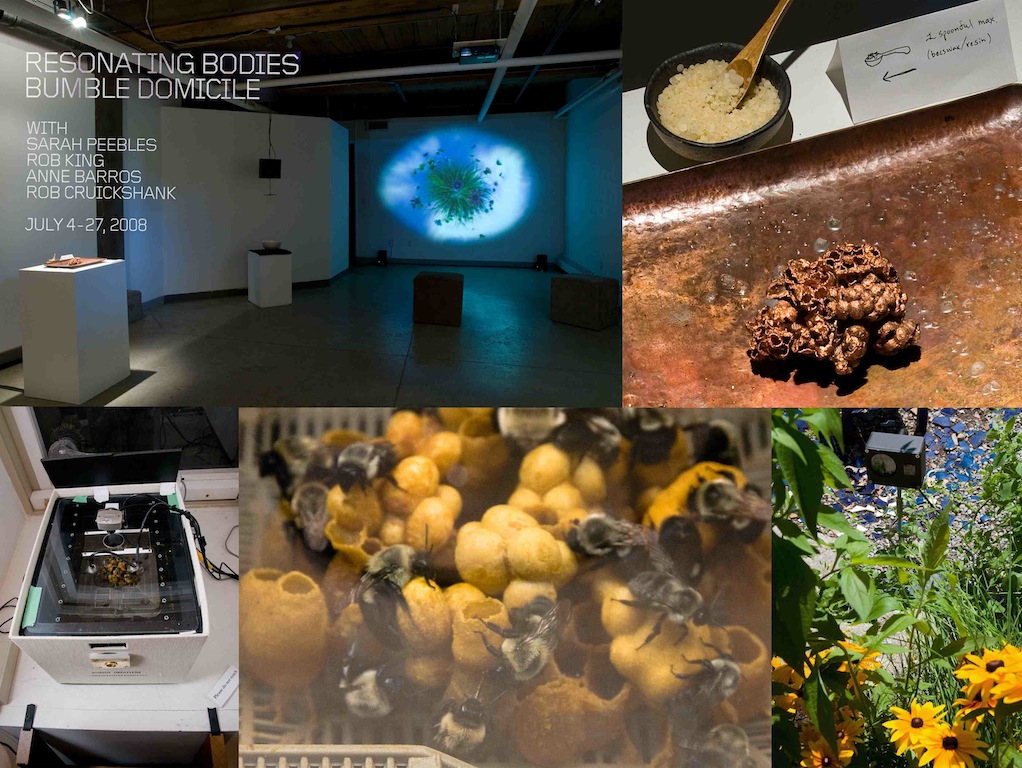
The two installments of the project, Bumble Domicile (2008) and Nest Wall (2009), highlight distinct features of bumble bees (which are social) and of solitary bees and wasps through observation of the physical world, visual and audio transformations, scent, touch and genetic and other biological information. Bumble Domicile weaves observation of an on-site bumble bee hive containing live video and audio of its internal activity, with the hive’s pollen-collecting activity, and real-time ultraviolet video of flowering plants in the building’s communal garden adjacent to the gallery. Portions of the garden are being cultivated and tended especially for the installation by the building’s tenant-gardeners and neighborhood youth involved in the CARE and Art in the Park programmes at Trinity Bellwoods (*new* gallery is located within the 900 Queen West Artscape artist tenant building).

The pollen-gathering activities of our bumble bees will be the focus of two cameras observing the hive. By routinely painting the stamens of a variety of plants in the adjacent garden and parklands with flourescent dye powders and by tracking their pollen collection via the cameras, data gathered over time will trigger the growth of virtual plants projected within the gallery space and will visually reflect the changes within the hive as a whole. Youth involved in Art in the Park will be swabbing anthers of various flowering plants in the garden and in Trinity Bellwoods Park with colourful flourescent dye insect tracking powders and keeping a log of their activities in the gallery.

Real-time (live) ultraviolet video of some flowering plants from the garden will be projected separately using an adapted video camera which has been modified and fitted with a UV filter. This will reveal petal markings visible only in ultraviolet light, known to function as pollen guides for bees and other pollinating insects (markings invisible to the human eye, but visible to bees and other insects).

Visitors are invited to place aromatic offerings of beeswax and pine resin - materials utilized within honey beehives and some solitary bee nests - into a heated copper tray which resembles the interior of our bumble bee hive, and which has been created through an electroforming process involving the remnants of a discarded bumble bee hive.

Continuous audio transformations of pre-recorded bees and shoh -- the Japanese mouth-organ, an instrument which has utilized beeswax and pine resin since ancient times - fill the gallery; headphones which “plug” into the actual hive bring together sight and sound of our bees as they go about their hive activities.

Free bee trading cards feature macro photography of bee anatomy, life facts and colour-coded DNA barcodes of some local bumble bee, megachile (leaf cutter) and osmia (spring bee) species. These will be on-hand with copies of “The guide to Toronto's Pollinators” booklet. Both art object and educational item, these cards are the first in a series of trading cards of pollinators featured in Resonating Bodies at both *new* gallery and at our Pink Bee-Wasp Condo at the Franklin Children’s Garden on Toronto Island, (our data gathering site for “Nest Wall” , 2009; more below).

Bumble Domicile is promoted via pins affixed to business cards, and feature multiples of a bombus hive interior and bee cartoon. Get yours at Interaccess, NAISA and around town!

Audio sample and visual reference: sarahpeebles.net/projects.htm#resonating

You can view our research as it progresses at Rob’s flicker site:

Research: photos by Rob Cruickshank

Download: "Hive Study no. 2" audio example (4:25 dur) 5MB

You can hear more of these sounds mixed with birds and other material in the previous works "Lift", "BeeSpace" (with Nilan Perera, guitar), and "Clear Dawn" (in 3 parts). Go to Sonus.ca and search "Peebles"; then select from the MP3 files with notes.

www.sonus.ca

Biographies end of document.

Pink Bee-Wasp Condo at Franklin Children’s Garden,
City of Toronto Parks and Recreation, on Centre Island.
Spring 2008 onward (permanent) - July 10 opening event

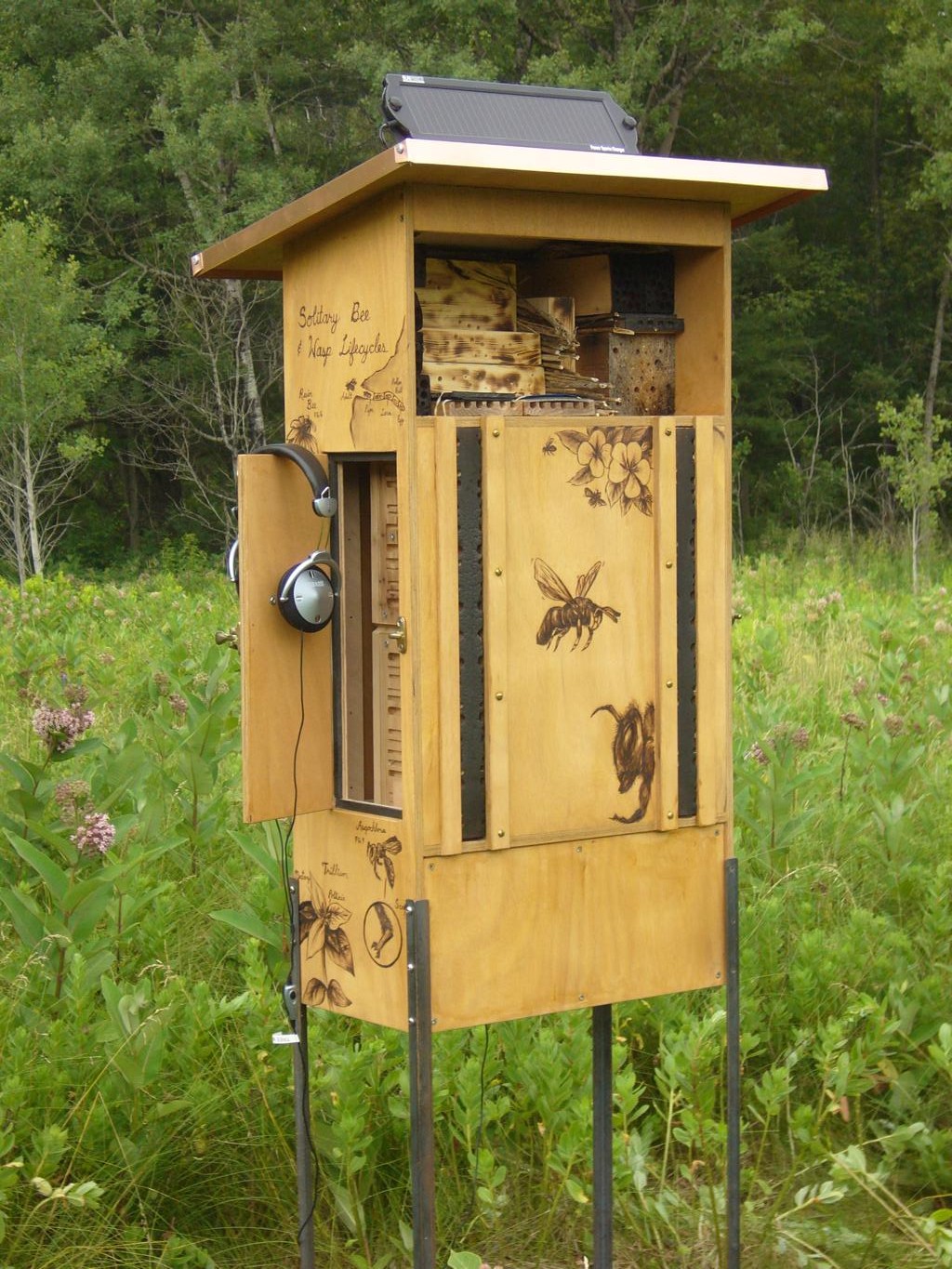
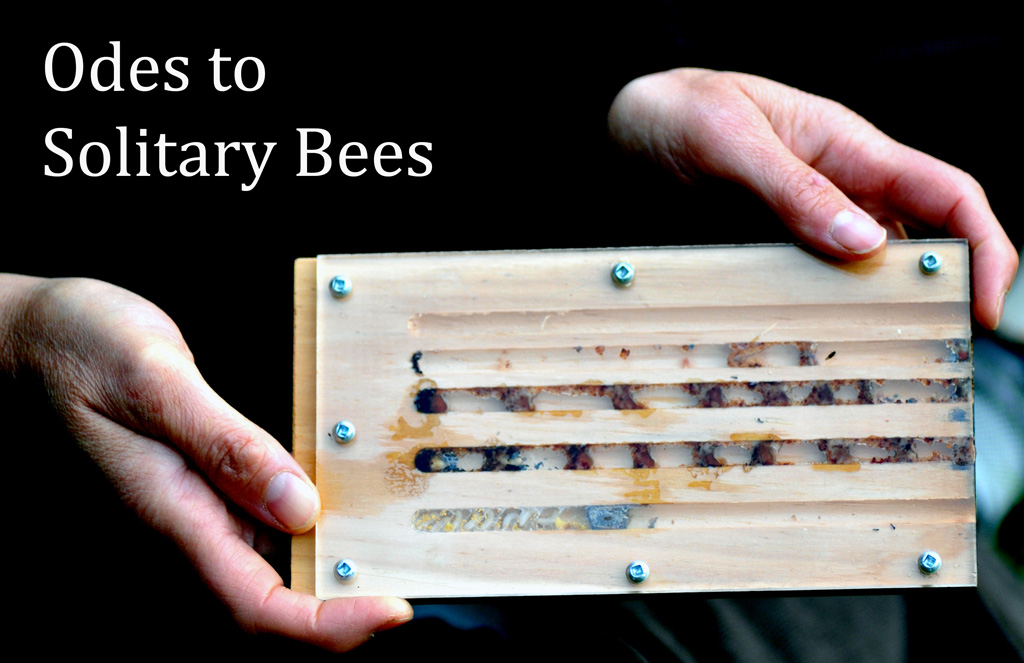
Come visit the Pink Bee -Wasp Condo! Free and open to the public year round, more than 20 species of solitary native bees and wasps can be viewed emerging, nest-building, visiting flowering plants and collecting materials in the garden and surrounding park. These observation nest blocks, specially designed independent researcher Dr. Peter Hallett (University of Toronto), can be viewed anytime via binoculars, and up close at special viewing times arranged by FCG staff, who will often be present to answer questions. The condo is permanent, but we’re gathering data this Spring and Summer of its seasonal activity for the second part of Resonating Bodies, Nest Wall (2009).

Nest Wall will involve an encaustic /mixed media work which will refer in form and content to these trap-nested wild pollinators. Via a series of embedded heating elements which will act upon bees wax and other embedded media, the work will transform slowly over the course of the exhibit at a rate roughly analogous to the insects’ Spring through Fall life cycles as compressed in time. Each residing species will be featured in our trading card series in 2008 and 2009. The observation nest blocks (and their inhabitants), are donated to FCG by independent researcher Dr. Peter Hallett. Special events and ongoing educational activities will take place through the FCG programmes, among others (toronto.ca/parks/franklin/index.htm).


Above: leafcutter bee (megachile pugnata) at an observation nest designed by Peter Hallett, who is recording competetive interactions of solitary bees and wasps within “trap nests” via sensus at Toronto area sites. Photo: Rob Cruickshank, at Koffler Scientific Reserve at Jokers Hill – University of Toronto.

Intimate Relationships

Plants and their pollinators began evolving their intricate dance of codependency over 100 million years ago with the origin of the flowering plants (angiosperms). They fine-tuned it during the Cenozoic era (beginning 65 million years ago) as flowering plants began to dominate all the world’s living landscapes. These millions of years of plant-pollinator coevolution have produced a world in which flowers have their anatomy and scents finely tuned to their pollinator partners. In exchange for pollination services, flowers provide food (nectar, pollen), shelter, and chemicals used by insects to produce such things as pheromones (chemicals produced by animals and released into the environment to stimulate a behavioural response from another animal). The relationship between flowering plants and their pollinators is so intimate that, should pollinator populations decline (or worse yet, go extinct), the impact on their plant associates would be immediate and profound. Because pollinators are species upon which the lives of so many other species depend, they are regarded as “keystone species”. Pollinators are thus essential to the stability of the global ecosystem itself. In fact, without pollinators, life on planet Earth would be very different.

Not only are our native plants dependent upon pollinators for their continued existence, but so are our crops. Eighty percent of the world’s crop species, including food, beverage, medicine, dye, and fiber crops, rely on animal pollinators. The critical importance of pollination has been recognized since humans first gave up nomadic lifestyles. That great symbol of human-pollinator partnering, beekeeping, began long ago, at least by 600 B.C. in the Nile Valley and probably well before that. The first beekeepers were most likely Egyptians who floated hives up and down the Nile to provide pollination services to floodplain farmers while simultaneously producing a honey crop. Domestic honey bees (Apis mellifera), introduced to North America from Europe in the mid-1600s, now play a role in pollinating 80 percent of the crop varieties grown in the United States and a significant percentage in Canada. However, the story is complex. Because European honey bees have been introduced worldwide they now compete with native bees (and other native insects) around the world, and it is now virtually impossible to find an area free of managed or feral honey bees.

Honey bees out-compete native insect pollinators by overwhelming them with their sheer numbers and superior ability to detect and direct one another to pollen and nectar sources. Further complicating the story, at the same time that the almost the whole world has become dependent on domestic honey bees, their populations are declining in many parts of the world, including Canada, due to exotic (introduced) bee parasites (e.g., mites, beetles), loss of habitat and, use of pesticides, and the invasion by highly aggressive Africanized bees (A. mellifera scutellata) into the United States (since 1990). The aggressive Africanized bees out-compete the European honey bees but do not pollinate all the same plants and crops. The direct competition between European and Africanized honey bees with native species is reducing the numbers of native pollinators, and it is adding to the pollination crisis that the world faces today. And most recently we have colony collapse disorder, which does not seem to be impacting Canadian beekeepers, at least not yet.

Like many other animals on Earth, pollinators today face growing threats of extinction. Disruption of habitat, widespread and often inappropriate use of pesticides, and the development of certain genetically engineered plants further add to the crisis, as pollinating insects are locally extirpated and native plant and domestic crop reproduction and fruit production plummet. It is suspected that many thousands of pollinator species have become extinct over the past century as a result of worldwide, rampant land-use change and deforestation. With accelerating global biodiversity losses, estimates of the number of insect species alone that will go extinct by the year 2050 range into the hundreds of thousands. The impact on native plants and on crops cannot be predicted in detail, but will surely be enormous.

— Richard C. Brusca, Executive Program Director, Arizona-Sonora Desert Museum


General introduction to bees

When we think of bees, we tend to think of honey, wax candles, venomous stings, traditional and reinvented apitherapies. As of late, we ponder more seriously their declining numbers and mass disappearing acts, and how we ultimately rely on them for much of our food, most of which is true and which is relevant — regarding the world of honeybees. What most of us aren’t aware of are the 19,000 (and counting) diverse species of bees world-wide (most of which are not honeybees; hundreds of which are found in Canada), their ancient associations with plants and ecosystems which make up the world as we know it, and their place in the bigger picture of the earth’s pollination story. This story includes moths, butterflies, beetles, birds, wasps, bats and even a few larger mammals. It involves “pollination corridors”— routes which maintain migrating pollinators like hummingbirds and Monarch butterflies — routes which can extend thousands of miles, from the Arctic to Mexico. It encompasses a wide variety of survival strategies on the parts of pollinating animals and the plants on which they depend, strategies honed through the ages in an ever-evolving dance of adaptation through time and change, including change resulting from human presence. It involves genetic diversity, that essential ingredient to the survival of all living things on Earth, including us.

So, who are these indigenous bees? Most of us know so little about them: where they live, when they live and when they’re active, what they look like, how they nest, what they eat, where they forage, how they navigate, how they communicate, what they pollinate. We don’t even really know if or how they positively affect - or might affect - our capacity to produce food sustainably, given our penchant for monocultural practices (including the pollinators we use). It is known that there are at least some 800 species of indigenous bees in Canada, perhaps 150 of which still exist in the Greater Toronto Area. Some live in small groups, most live entirely alone, in their very own apartments. And somehow they manage to make it through the Winter. Let’s meet them, up close and personal.

Bombus  Bumble bee colonies in nature often live underground in hollows such as discarded mouse nests. Their colonies grow throughout the summer months and naturally die off by the first frost. The mated new queens then find different underground locations in which to over-winter to start a new colony cycle the following Spring. Bumble Domicile’s live observation hive is developed, implemented and monitored with assistance from the Professor James D. Thomson lab at the University of Toronto Department of Ecology and Evolutionary Biology. Bombus impatiens are its residents and are one of many species of bombus which live in Toronto. Wasps Wasps are largely carnivores. Bees, which evolved from wasps, are believed to have made the scene about the same time as flowering plants.

Wasps also pollinate, though most do to a much lesser extent. Like bees, many species of wasps are solitary (do not live in hives), living here and there in bramble, loose earth, mud constructions, etc., and thus have taken up residence in the observation nests which we are monitoring for part 2 of Resonating Bodies, “Nest Wall” for 2009 (see below). Colour-coded DNA barcodes of local bee and wasp species appear throughout Resonating Bodies in various forms and contexts. These barcodes serve as a metaphor for biodiversity and evolving strategies of pollinators, and by extension, of all living things. They also serve as representations of our ability to perceive (with the aid of technology) and better understand the genetic aspects of the biological diversity of the region in which we live through a specific group of pollinators indigenous to this region, whom we can observe in their “natural” habitats via our in-house bumble bee hive with adjacent garden (at *new* gallery), and, at our pink bee-wasp condo at The Franklin Children’s Garden on Toronto Island (toronto.ca/parks/franklin/index.htm).

— Sarah Peebles

Safety note: The bumblebee hive at *new* gallery will be quite small, and will grow throughout the month of July to about 20 workers in total, about half of whom will be foragers (i.e. bees which come and go from the hive). All bees in upper North America, including bumble bees and solitary bees are, by nature, non-aggressive to people and are not interested in human food of any type, but rather forage for nectar and pollen exclusively. The same is true for solitary wasps, except that they prey upon aphids, grasshoppers and other insects. Thus, they will not take an interest in people observing their foraging activities and will only sting if accidentally stepped on or handled. Bee populations at the garden adjacent to *new* gallery (and, bee and wasp populations and at Franklin Children’s Garden) will not be noticeably greater than those normally present, and as such persons with allergies should take the same precautions as in any outdoor situation. No bees will be free within the *new* gallery.

Technical assistance and consultation: Dr. Laurence Packer, Professor of Biology, York University; Jessamyn Manson and Michael Otterstader and James D. Thomson Lab, University of Toronto Department of Ecology and Evolutionary Biology; Dr. Stephen L. Buchmann, adjunct professor of Entomology at the University of Arizona, Tucson (co-author, “The Forgotten Pollinators”); and Professor Peter Hallett, University of Toronto and Department of Natural History, Royal Ontario Museum, in co-ordination with Koffler Scientific Reserve at Jokers Hill –University of Toronto.

Ad card hive images by Rob Cruickshank, cartoon by Kat Cruickshank (pin), ad card and trading card designs by Anneli West. Colour-coded DNA barcode courtesy BOLD systems (trading cards, web site).

pollinator.org
Pollinator Partnership provides information on pollinator - habitat conservation, pollinator gardens, co-evolution and more; this site brings together information regarding Mexico, the United States and Canada.

pollinationcanada.ca provides valuable additional insight into Canada-specific issues of topics related to pollination.

Resonating Bodies is generously supported through the Drylands Institute, InterAccess Electronic Media Arts Centre, New Adventures in Sound Art and the City of Toronto Parks and Recreation.

Speakers Series: Indigenous Pollinators, Habitat and Co-evolution

Researchers and artists speak about pollinator and bee biodiversity, habitat and related topics throughout the month of July at various venues. Co-presented by Seeds of Diversity and InterAccess, Dorkbot and Franklin Children’s Garden. Updates at interaccess.org.

Thursday July 10 (date and times to be confirmed): “Social and Solitary Bees”
A bee-wasp condo opening, with story reading, talks, snacks and pollinator walk.


Featuring Dr. Stephen Buchman, Dr. Peter Hallett and Dr. Laurence Packer.
Franklin Children’s Garden - City of Toronto Parks and Recreation, Toronto Centre Island
(via Centre Island ferry, directions and updates at toronto.ca/parks/franklin/index.htm)

Dr. Stephen L. Buchmann, adjunct professor of Entomology at the University of Arizona in Tucson, co-author, “The Forgotten Pollinators”, reads his book “The Bee Tree” (ages 4 and up)

Professor Peter Hallett, University of Toronto and Department of Natural History, Royal Ontario Museum (in co-ordination with Koffler Scientific Reserve at Jokers Hill –University of Toronto): Introduction to bee-wasp condos, lives of local solitary bees and wasps, and his long-term work developing and observing trap nest blocks (bee condo contributor)

Dr. Laurence Packer, Professor of Professor of Biology at York University:
Introduction to “A Guide to Toronto's Pollinators” and his amazing collection of world-wide bee specimens!

Sat July 12, 7:00 p.m.: “The Forgotten Pollinators”

Featuring Dr. Stephen L. Buchmann (Tucson, AZ).
InterAccess Electronic Media Arts Centre Studio, 9 Ossington Ave at Queen W.

Dr. Stephen L. Buchmann, adjunct professor of Entomology at the University of Arizona in Tucson, co-author, “The Forgotten Pollinators”, North American Pollinator Protection Campaign executive steering committee / International Coordinator, President - Drylands Institute, photographer, consultant: Speaking on pollinator/habitat co-evolution, indigenous pollinators, food security issues and his involvement with the Sonora Desert Museum pollinator gardens.

Thursday July 17, 7:00 p.m. (date to be confirmed): “Barcodes and Bees?”

Featuring Professor Laurence Packer (York University) and Resonating Bodies artists. A Dorkbot event at InterAccess Electronic Media Arts Centre Studio, 9 Ossington Ave at Queen W. (dorkbot.org/dorkbottoronto/

Dr. Laurence Packer, Professor of Biology and Environmental Studies at York University, author of “Bees of Toronto”: Speaking on Canada’s native bees, pollinator biodiversity and pollinator-habitat relationships; emphasizing recent research regarding DNA barcode data in understanding the bees of Canada.

Artists Sarah Peebles, Rob King, Anne Barros and Robert Cruickshank talk about their interdisciplinary work, “Resonating Bodies - Bumble Domicile” exhibiting at *new* gallery July 4 - 27 (Co-Presented by InterAccess and NAISA). Topics include visualization of pollen gathering data, ultraviolet video / bee vision, the electroforming process, and audio transformations of bee sounds.

Sunday July 20, 4 p.m. (see web site for venue):
“Plants affecting pollinators: How plants lure bumblebees into making plant babies”


Featuring Jessamyn Manson (University of Toronto)

Jessamyn Manson, a Ph.D. candidate from the University of Toronto Department of Ecology and Evolutionary Biology, will speak about the interaction between plants and their pollinators, focusing on how plant traits like flower colour, scent and reward convince bumblebees to act as pollen vectors. Jessamyn will also discuss how the rewards collected by bumble bees affect bee health and performance.

Media Contact: laura [dot] paolini [at] interaccess [dot] org
Information and updates at interaccess.org

pollinator.org
Pollinator Partnership provides information on pollinator - habitat conservation, pollinator gardens, co-evolution and more; this site brings together information regarding Mexico, the United States and Canada.

pollinationcanada.ca provides valuable additional insight into Canada-specific issues of topics related to pollination.

Resonating Bodies is generously supported through the Drylands Institute, InterAccess Electronic Media Arts Centre, New Adventures in Sound Art and the City of Toronto Parks and Recreation.

Artist and Technician Biographies (alphabetically listed)

Anne Barros, RCA, received a BA from the College of New Rochelle and an honours diploma in Gold and Silversmithing from Humber College, Toronto. After further study at the Sir John Cass School of Art in London, England, she began practice as a studio silversmith with a specialty in small functional holloware and flatware. Her work has been featured in exhibitions in Canada, the United States, and Germany, and is included in the permanent collections of the Canadian Museum of Civilization, Seymour Rabinovitch, and the Macdonald Stewart Art Centre. She has received numerous awards, including the Canada Council’s Paris Studio. Recent exhibitions include: Manifesta: vision and mastery in contemporary craft, Gallery Stratford (2004), In Service, Nova Scotia College of Art and Design (2004), Fork Lifting, *new* gallery, Toronto (2003). Contact mabarros [at] sympatico [dot] ca

Robert Cruickshank is a Toronto-based multidisciplinary artist. His work in various media includes electronic, kinetic and robotic installations, sound art, electroacoustic music and lo-fi and stereo photography, and has been exhibited in Toronto and internationally. Much of his activity is associated with InterAccess Electronic Media Arts Centre in Toronto, where he has developed a number of hands-on workshops for artists using electronics. His work combines a knowledge of physical computing with an ongoing fascination with sound, light, and motion, and is as much informed by the kinetic art of the early 20th century as it is by contemporary new media art. Works such as Spiral Inscriber (2005) and Sheep Problem (2007) combine micro-controllers with intricate electro-mechanical systems, reminiscent of early clockwork and mechanical devices, and reflect his interest in obsolete technologies. Many of these works are collaborative in nature, and he has been part of several long-term collaborative projects at InterAccess, such as Space Probe (1998), SenseBus (1999) and Art Interface Device (2001 present). He is also a member of InterAccess' I/O media, a collective of sound and video artists who explore real-time improvised performance. In addition to his skills in electronics and physical computing, Cruickshank brings an extensive background in broadcast technology to his work, and has been a sought-after advisor to artists seeking technical assistance for many years. He brings to this project his expertise in imaging technology, as well as a life-long fascination with ultraviolet light, which is often incorporated into his own artwork. He has sat on the InterAccess Board of Directors from 1996 to the present Contact robcruic [at] sympatico [dot] ca Web: robcruickshank.net

Rob King is a New Media artist, visualist, programmer and researcher based in Toronto, Ontario. He has a BFA in Image Arts: New Media from Ryerson University, and is currently finishing a MA degree in the Communications and Culture joint graduate program at Ryerson and York Universities. His work explores the social dynamics of networked spaces, the potentials of mobile and ubiquitous computing, dynamic and generative processes, intellectual property issues, and system theory. In 2004-5 Rob developed the Locus Experimental Social Interface, an instant messaging program that used machine learning techniques similar to those used by spam e-mail filters to analyze users online conversations. The program found similarities in the ways people conversed online and visualized the results in a variety of literal and abstract ways. Locus was shown in July 2005 as a part of the Pulse exhibition at the Interaccess Electronic Media Arts Center in Toronto, and prints from Locus were shown at the Ryerson President's Office Exhibition for 2005-2006. Aside from his experiments in social computing, Rob has developed a number of mobile projects and academic research tools. He is the developer of PlayLive, and PSP2MIDI, two applications that enable artists to control digital audio software wirelessly from a Playstation Portable game console. As a visualist, Rob has developed and performed live visual accompaniment with the Toronto-based improvised AV collective I/O Media, sound artists Smash and Teeny, and electronic musician Sans Soleil. Rob also helped develop the mobile projects VIRJ and Things Left Unsaid for Canadian Film Centre Media Lab, and was the primary developer of the Webivore web-scraper tool used by Ryerson University's Infoscape Research Lab. Currently Rob is finishing his MA, and developing a tool to easily enable artists to create networked and collaborative artworks, and I/O mashups. Contact rob[ at] e-mu [dot] org Web: e-mu.org

Sarah Peebles is a composer, improviser and installation artist. Her studies have included violin, composition and Japanese traditional musics at the University of Michigan School of Music, Toho Gakuen School of Music (Tokyo), Tokyo Association of Shinto Priests and The Okada guild, among others. Much of her practice focuses on found sound manipulated on computer projected via loudspeakers and/or physical objects, often in conjunction with her acoustic and digitally processed shoh performance (Japanese mouth-organ). Her activities have included music for dance, multi-channel sound, radio, video/film, performance art, new media and improvised performance. Venues and producers include Deutchland Radio, BBC3, Radio-Canada, Radio New Zealand, New Adventures in Sound Art, Open Ears Festival, The Kitchen, SIGGRAPH Electronic Theater Evening, The Adelaide Festival of Arts-The Listening Room (ABC), New Adventures in Sound Art, Festival L’espace du Son, Continuum ensemble and the McCluen Festival of the Future. She has received awards from ASCAP, BMI, the McNight Foundation (ACF) and the Japan Foundation Uchida Fellowship, and grants from the Canada Council for the Arts and other provincial/regional funding. Peebles has collaborated with a wide range of musicians and artists, and her music is available on a number of audio and video publications. Contact sarahpeebles [at] gmail [dot] com Web: sarahpeebles.net

Guest Speaker, Bumble Domicile opening

Dr. Stephen L. Buchmann is an adjunct professor of entomology at the University of Arizona in Tucson. He has authored or co-authored 8 books, including the influential "The Forgotten Pollinators" (1996 from Island Press), along with 150 scientific publications. Buchmann has been influential in creating national and international policy for the conservation of bees and other pollinators along with the flowering plants they visit (e.g. Sao Paulo Declaration on Pollinators, the International Pollinator Initiative). Currently, he serves as chair of the research, and founding member of the executive steering committees for the North American Pollinator Protection Campaign (www.nappc.org and www.pollinator.org) a tri-national cooperative involving a120 organizations in Canada, USA and Mexico. Recently, he served on the U.S. National Academy of Sciences panel which published its 300 page report as a book "Status of Pollinators in North America" during April, 2007. Although a scientist by training, he is an accomplished photographer and experimenter with high technology. He uses a Creo flatbed scanner to image bees, butterflies and flowers, turning these up to 1 Gigabyte image files into fine art giclee inkjet prints and exhibits. For the past three years, he has been an instructor (digital print-making and scanography) for the Art Institute of the Arizona-Sonora Desert Museum based in Tucson. Buchmann was an associate producer for the Turner Original Films television documentary "Pollinators in Peril" which aired on the TBS super channel in April, 2000. His first children's book "The Bee Tree" was published in April, 2007 by Cinco Puntos Press, El Paso, Texas. Contact: stephenbuchmann [at] comcast [dot] net

Credits

Technical assistance and consultation: Dr. Laurence Packer, Professor of Biology, York University; Jessamyn Manson and Michael Otterstader and James D. Thomson Lab, University of Toronto Department of Ecology and Evolutionary Biology; Dr. Stephen L. Buchmann, author, adjunct
professor of Entomology at the University of Arizona, Tucson; and Professor Peter Hallett, University of Toronto and Department of Natural History, Royal Ontario Museum, in co-ordination with Koffler Scientific Reserve at Jokers Hill –University of Toronto.

Ad card hive images by Rob Cruickshank, cartoon by Kat Cruickshank (pin), ad card and trading card designs by Anneli West. Colour-coded DNA barcode courtesy BOLD systems (trading cards, web site).

Resonating Bodies is generously supported through the Drylands Institute, InterAccess Electronic Media Arts Centre, New Adventures in Sound Art and the City of Toronto Parks and Recreation.


»»» BACK TO TOP

Homepage | Artist Biography | Recordings / Publications
Max, Sample Cell, ABControl images | Cinnamon Sphere | Smash and Teeny | The Audible Woman
Protest CD | Reviews | Notable Projects | Contact the Artist at speeb@sympatico.ca | Resources | What's New?

 | Site updated by Four Corners Communications