108: Walking Through Tokyo at the turn of the century
Soundscape album (digital audio) available at BandCamp.
Enhanced audio CD with text and photos (post-004, 2002) Post-Concrète records. Available from ElectroCD (physical disc only)
CD player-compatible (audio). PC/Macintosh: audio with images (synchronized to audio, and random mode), and essay in English and Japanese language (also transferable to video ipod)
Sarah Peebles: 50-minute soundscape portrait of Tokyo
Christie Pearson: 40 images of Tokyo's architecture, public spaces and life;
Yoshimura Hiroshi: Essay on Tokyo's soundscape past and present (in Japanese and English).
"What could emerge as self-indulgent noise is instead an absorbing episodic sound collage, recalling a more cohesive version of one of Glenn Gould's 1960s radio documentaries."
~Eye Weekly
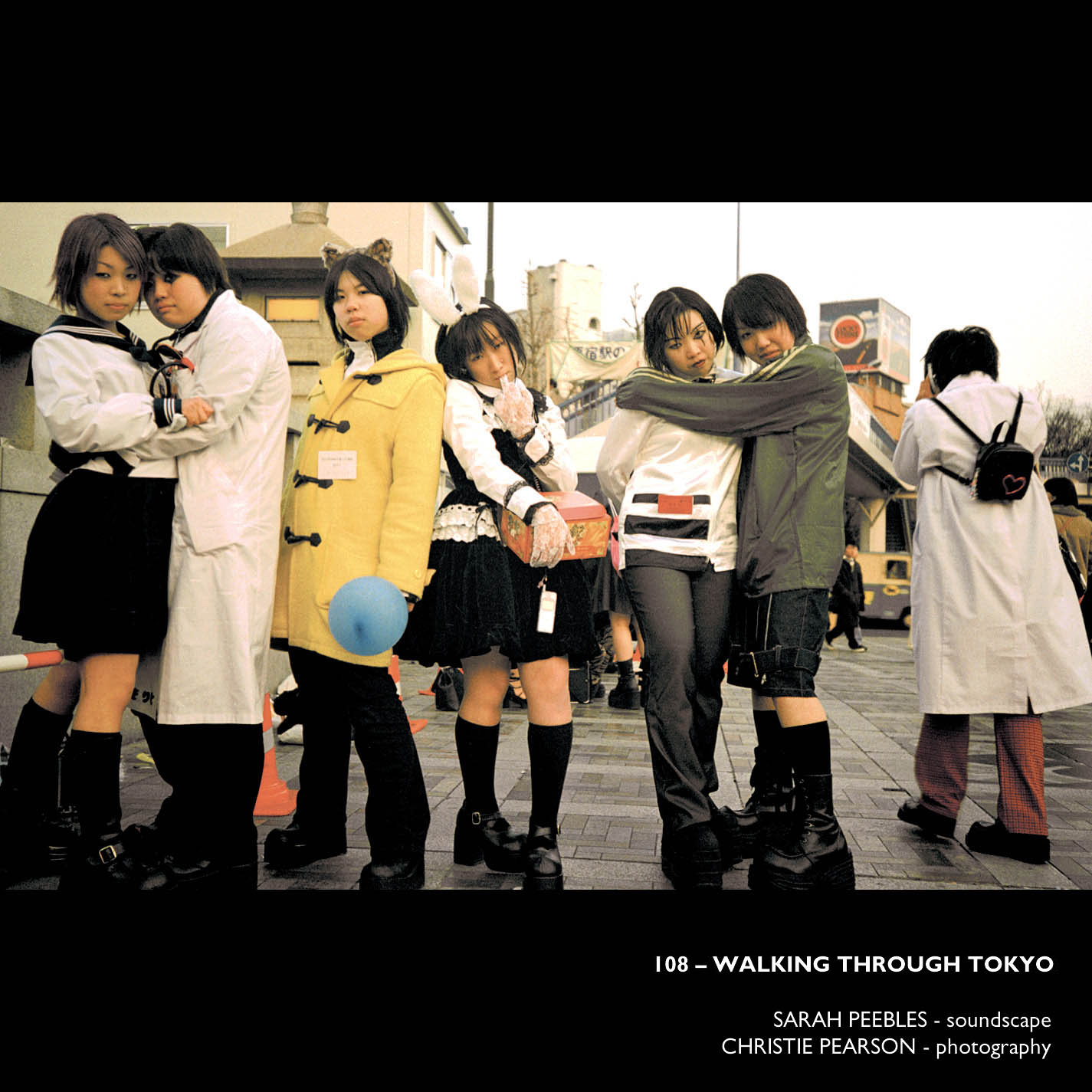
"Between each evocative street scene, Peebles masterfully creates a palpable sense of the joy of motion through urban spaces – the solid pneumatic hiss of the doors on the JR trains, station jingles and the learned nasal twang of a streetcar conductor. Christie Pearson's street photos on the enhanced CD add another dimension to an exquisitely sequenced piece of audio verité."
~The Wire
Tracks
- Fast Kitchen (South Shinjuku area)
- Yes, Christo (God is Eternal)
- Shinjuku Station (south entrance)
- Train Ride on Sobu Line
- Three Active Serves (video arcade, Yotsuya) | audio
- Pachinko (Yotsuya)
- New Year's Bells (Nishi Nippori)
- Kendo at Dawn (Japan University of Physical Education)
- Street car Ride (Setagaya Line)
- 3 for ¥500 (merchants at Ameyoko)
- Epilogue | audio & image
Hear all tracks at CBC Music-Sarah Peebles
Article: CEC — eContact! 4.3
A walk through the city, the microphone reveals the soundscape in a way one would perhaps perceive the world while walking: one’s attention focused and refocused in any given moment, the lines between reality, imagined, and remembered blurred. Tokyo’s ambient sonic environment is especially active and compelling. Even the space between sounds reveals intriguing aspects of this place, a city which has several large centres, each with their own distinct character, and no one down town core. These fifty minutes weave together modern and traditional hawking, evangelists' sermonizing, train riding, a video arcade and pachinko parlour, kendo en masse, and, at the centre of the piece, "joya no kane" — the annual ringing of temple bells 108 times at 12:00 A.M. each New Years Eve.
“Walking Through Tokyo” is a sonic and visual journey where images and sounds immerse the viewer in an alternative cityscape, composing a staggered narrative that doubles back on itself. The architecture of Tokyo brings the visitor into a free-fallout of expectations. It is a city constantly reconfiguring itself. Western conventions relating individual buildings to the public realm are absent, while startling adjacencies of scale, function, materials, and age question and reveal codes by which we attempt to read what is of value. Where to direct the eye amidst the simultaneous stimuli? In a cellular city devoid of street addresses, any mental map of monuments quickly becomes a mirage. A hasty consumption of physical forms creates a sense of the material world’s evanescence, transient fashions collapsing as quickly as buildings. the visual sequence here mirrors the sonic movement through a city of amplified juxtaposition: Eros and Thanatos; brightness and darkness; engagement and alienation. Tokyo shows us the fullness and void of the electric night.
In writing his introduction to this audio work, Japanese soundscape scholar and composer Hiroshi Yoshimura (1940 - 2003) penned an intriguing discourse on the nature of human sound from an Asian perspective, highlighting his observations on “sound chaos” and his research into temple bells of the Edo period. “The soundscape common to all of Asia is hustle and bustle. The noises of a bustling bazaar are indeed proof that the city is vibrant and viable... This is the same soundscape found in any city around the world, but compared to areas based in a European culture, there is a certain boisterous quality characterizing the soundscapes of cities of Asian culture. This soundscape seems almost to lose the quality of noise, and comes across more as a smell, almost like body odour, so that the noise of the city that might have been perceived as bothersome becomes soothing. In the globalized digital world only uniform information has come to be communicated. It is lacking in that something extra that we perceive only with our five senses.” —Yoshimura (excerpt)
"108" soundscape was commissioned by Radio-Canada for the radio program, L'espace du son. Recorded December, 1999 - January, 2000. Broadcast on "la Chaîne Culturelle" (February, 2001); produced by Mario Gauthier.
"108—Walking Through Toyko" is also a video installation work (2006/2018), details at Projects.
Full video presented online by The Wire.
108 Walking Through Tokyo at the Turn of the Century soundscape details:
- Fast Kitchen (South Shinjuku area)
Sidewalks, shops (with mini-speakers on ground), fast-food woman with microphone and pre-taped advertisement along Koushuu-kaidou road. - Yes, Christo (God is Eternal)
Evangelist tape amplified from sidewalk, vending stand, beside Shinjuku Station's South Entrance. - Shinjuku Station (south entrance)
Ticket vending machines, telephone, wicket beeps, train arrival/departure music. - Train Ride on Sobu Line
Stopping at Shinjuku, Yoyogi, Sendagaya, Shinanomachi, and Yotsuya stations; with train arrival/departure music, announcers. - Three Active Serves (video arcade, Yotsuya)
A blend of 4 players' activities; pause at Akihabara station. - Pachinko (Yotsuya)
Ends with sidewalk boutique mini-lousspeaker and bus: excerpt, "KOKODE KISS SHITE" by Shiina Ringo / Toshiba-Emi (3rd Maxi-Single January 20,1999 TOCT-4133). - New Year's Bells (Nishi Nippori)
From the perspective of a temple graveyard, 12:10 a.m., January 1, 2000; walking through the neighborhood to the 108th strike of a nearby temple. - Kendo at Dawn (Japan University of Physical Education)
Kangeiko New Year's work-out at Nihon Taiku Daigaku. Big thanks to Aoki-sensei and the Nittai-dai Judo Club, to Bill May for peanut butter sandwiches, and to Maureen Randolph (wherever you are). - Street car Ride (Setagaya Line)
From Sangenjaya to Wakabayashi/Shimokitazawa stations. - 3 for ¥500 (merchants at Ameyoko)
Along the train tracks from Okachimachi to Ueno stations lies Ame Yoko shopping district. Great bargains, lovely people. - Epilogue
Processed train rail whines and pachinko; 6 p.m. temple bell at Kokushōji (Agui-cho, Kita-gun, Aichi Prefecture).

"What's incredible listening to "108" is the fact that the very characters of noise, confusion and - not to exaggerate - stress one usually gets in metropolitan environment become - little by little - appreciated companions in any of their particular inflexions... Here you have the total meeting: the body has time to settle down, the mind can work in spans at last. Contrarily to similar projects that just draw a blank, Sarah's soundscape needs to be listened with polished ears."
- Massimo Ricci, Touching Extremes
"Without even trying, an honesty elevates it beyond clinical wiretapping.... the main technique is total, pure location and environmental concrete."
- Vince Harrigan, Manifold Records
"My fourteen year old son has unequivocably declared it is cool". In fact, he was so excited than he ran over to me immediately and demanded where it came from and has since absconded with it to let his music teacher (the music teacher is also "cool") to listen to it. The music teacher also thought it was "cool", which of course is really "cool".
- Deirdre Tanaka, Toronto
Listening and Viewing Technical Notes (E-CD only)
This enhanced CD is designed to work in CD and DVD players (audio portion) and on a PC or Macintosh computer (audio-visual). To view the images and slide shows, insert the CD into your computer and click on the "108.html" document (the menu). "Manual View" and "Auto View - Random" will engage when selected from the menu. Begin the audio and visuals manually (you'll have to do these two things separately).
A special synchronized slide show has been composed by photographer Christie Pearson to unfold along with the audio: copy both the "data" folder and "108.html" document onto your hard drive, then click "Synched View" from the html browser and begin the audio (separately) at the same time (or as close as possible).
Home Page |
Artist Biography |
Recordings & Publications |
Online Audio/Video
Projects & Performances |
Reviews |
Archives 2001-2011 |
The Audible Woman
Contact the artist at sarahpeebles @ gmail.com